
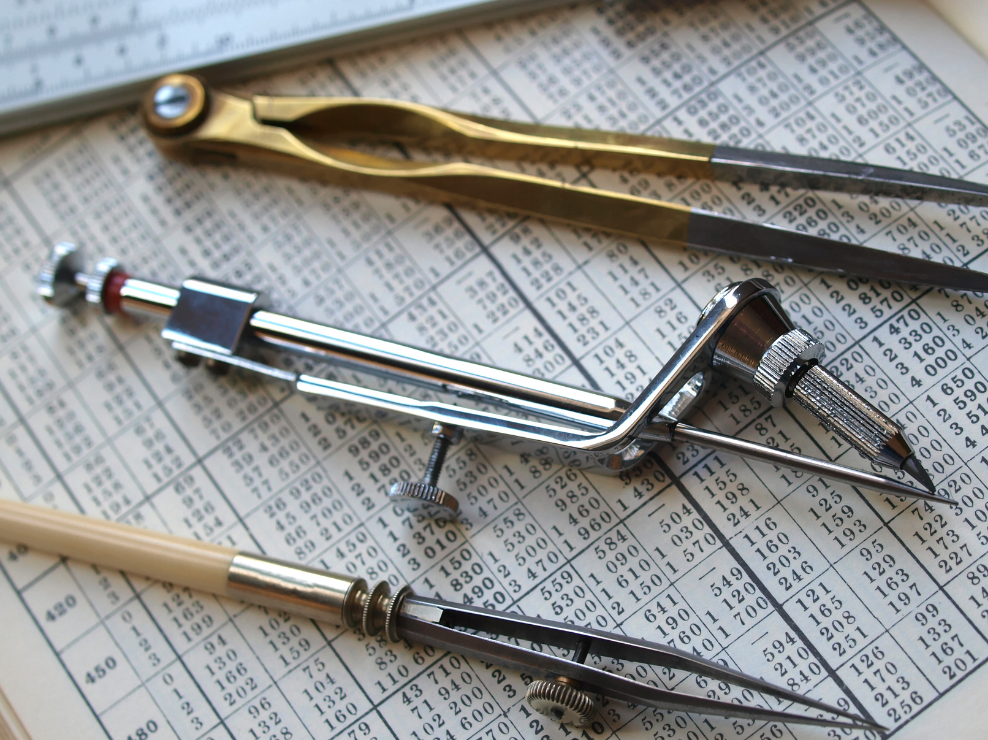
In the late 1920s, engineering was a manual and meticulous profession.
Engineering has always been a field driven by innovation and problem-solving. Looking back to 1926, we see a world vastly different from what engineers experience today. A mere century has transformed how engineers approach their work, with significant advancements in tools and technology. Let’s explore the stark contrasts between the engineering tools and methods of 1926 and the sophisticated technology that defines the profession in 2026.
Tools of the Trade in 1926
Engineers in the past relied heavily on calculating tools that were fundamental to their work. Slide rules were essential for performing complex calculations, as they required a high level of mathematical proficiency and utilized logarithmic scales for multiplication and division. In addition to these devices, manual look-up tables were critical for empirical formulas, including the Hazen-Williams equation and the Manning formula.
When it came to drafting, creativity and skill were front and center! Engineers meticulously crafted designs by hand on drafting tables, utilizing essentials like T-squares and French curves to ensure every detail was just right. The process of reproducing drawings with traditional blueprint machines combined art and science, using chemical methods to develop the blueprints and reflecting the hands-on nature of engineering during this era.
Communication methods were also quite different from today’s standards. The primary means of communication among engineers was corded telephones, which connected through switchboards. In larger firms, pneumatic tube systems facilitated the swift transfer of messages and plans.
Meanwhile, the seeds of computing were only beginning to sprout. Visionaries like Vannevar Bush were paving the way for advancements in the field, developing analog computers such as the Differential Analyzer. Although designed to solve differential equations, the innovative machine was far from the fast, efficient computing capabilities we enjoy today.
The Modern Toolbox in 2026
Fast forward to 2026, and engineers benefit immensely from advanced software tools that enhance their capabilities in simulations, modeling, and design. Programs such as Computer-Aided Design (CAD) and Building Information Modeling (BIM) enable precision and real-time collaboration, significantly reducing project completion times.
The evolution of digital calculations has also transformed the field; high-performance computers and sophisticated software applications have rendered slide rules obsolete. Engineers can now perform complex calculations instantaneously using advanced algorithms, machine learning, and simulations, leading to more in-depth analysis of data and systems.
Moreover, the advent of rapid prototyping technologies such as 3D printing has revolutionized how engineers turn their designs into reality. This innovative approach facilitates iterative testing and refinement before moving on to production, ultimately saving both time and resources.
Enhanced communication tools have connected engineers across the globe, enabling them to collaborate through instant messaging, videoconferencing, and various collaborative platforms. This connectivity fosters teamwork over distances, promoting the swift exchange of ideas and immediate resolution of challenges.
The most exciting development in engineering is the integration of artificial intelligence (AI) and machine learning into everyday practices. Engineers can now leverage AI to optimize designs, predict system behaviors, and even automate repetitive tasks. This shift not only streamlines processes but also frees up valuable time for creative problem-solving and innovation.
Conclusion
The evolution of engineering tools from 1926 to 2026 is a shining testament to human ingenuity and advancement. While engineers of the past relied on manual skills and physical tools, today’s engineers are empowered by technology that enhances accuracy, efficiency, and collaboration. As we look forward, it will be fascinating to see how engineering continues to evolve with emerging technologies and societal needs, paving the way for innovations we can only begin to imagine.

Put our technology to work for you.
OptimizerPS uses real-world data to assess pump performance, identify inefficiencies, and guide proactive maintenance decisions.