
Rick Kelly’s journey in engineering illustrates the powers of innovation and personal resilience.
As Rick Kelly can attest, the engineering landscape is one of continuous innovation and adaptation. With more than two decades of experience in the field, Rick’s journey is a testament to the importance of embracing change, fostering relationships, and continuously learning.
The Road to Jones & Henry
Rick Kelly’s path to engineering wasn’t straightforward. Rick initially aspired to become a teacher, motivated by a desire to coach and mentor young athletes. However, an unexpected fascination with heavy highway construction sparked a new passion for engineering that would shape his future.
Born and raised in Ashtabula, Ohio, about an hour northeast of Cleveland, Rick enjoyed playing sports, particularly football and baseball, while attending Jefferson Area High School. A pivotal moment came at the age of 17 when he participated in the People to People Student Ambassador Program, spending three enlightening weeks traveling through Australia and New Zealand with other students. The experience not only broadened his horizons but also ignited his thirst for knowledge and exploration.
Rick enrolled at Ohio Northern University in 1995, where he lived on campus and joined the Delta Sigma Phi fraternity. The transition from high school to college proved to be tougher than he anticipated. “I pretty much breezed through high school without learning how to study,” Rick reflects. “College introduced me to active learning.”
In 1999, Rick earned his Bachelor of Science in Civil Engineering, marking the beginning of a robust career in the field. He began his professional journey at CT Consultants and subsequently held roles at Vitech, Resource International Inc., and, eventually, McKissack & McKissack. His work involved designing various municipal projects, including sanitary and storm sewers, and pioneering innovative methods for assessing aerial sewers.
After a period of extensive travel and remote work, Rick missed the joys of teamwork and camaraderie. “So much of what we do as engineers is collaborative, so I wanted to work in an office again,” he remembers.
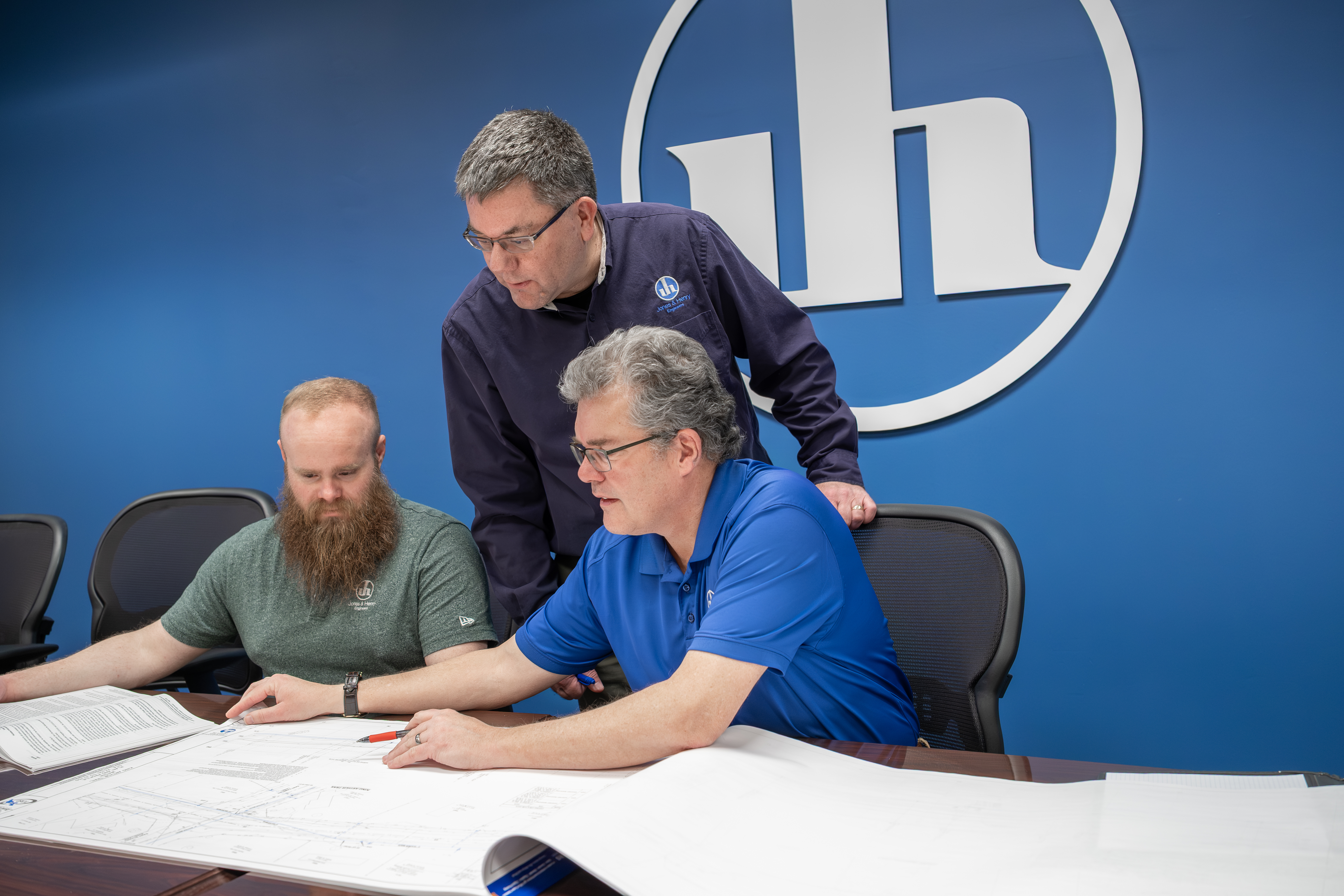
In March 2023, he found a new opportunity at Jones & Henry’s Cincinnati office. There, he quickly recognized the warmth of the company’s collaborative culture. “There are a lot of high-quality, level-headed people working here,” he notes, appreciating the supportive environment that aligns with his personal values. “I like the small company feel and local ownership structure.”
Rick is also enthusiastic about the company’s 100th anniversary. “It is a testimony to the quality of people who have contributed to this company over time,” he says. “This company has learned what it does well, and it sticks to it.”
Family Life
Rick lives in Northern Kentucky near Independence, just a short commute from the Cincinnati office. He and his wife are proud parents to a 13-year-old daughter and a nine-year-old son, both adopted. This year, Rick will finally fulfill his long-held goal of becoming a baseball coach.
When they’re not juggling busy schedules, the family enjoys spending time at the beach. The Gulf Coast of Florida is a frequent favorite, as is Gatlinburg, Tennessee, which offers numerous family-friendly activities.
Rick’s journey hasn’t been without its challenges. Two years ago, he suffered a massive heart attack caused by the total blockage of his Left Anterior Descending artery. Known for its low 12 percent survival rate, the condition is often dubbed a “widow maker” heart attack.
“My wife says I’m too stubborn to die,” he quips, but the experience has profoundly shaped his perspective on life and work, reinforcing the importance of cherishing every moment.
The Future of Engineering
As the engineering field continues to evolve, Rick is both excited and cautious about the role of artificial intelligence. While new technologies promise enhanced efficiency and predictive capabilities, Rick emphasizes that AI cannot replace the essential human judgment and experience that engineers bring to the table.
Rick is especially intrigued by programs that utilize data collected over time from water systems to predict future water main breaks. That forward-thinking approach allows communities with aging infrastructure to proactively plan repairs and replacements rather than merely reacting to issues as they arise. Additionally, AI could help address the growing shortage of engineers.
But despite its benefits, Rick firmly believes that the heart of engineering lies in human intuition and critical thinking. “Only with experience doing calculations by hand can an engineer learn how to make crucial decisions,” he asserts.
“I recommend engineering as a career to young people because it is a discipline that society will always need,” he advises. He emphasizes that, along with technical expertise, problem-solving skills, relationship-building, effective communication, and a willingness to embrace technological advancements—including AI—are essential for success in the field.
As Rick continues his journey with Jones & Henry Engineering, he embraces the opportunity to leave a meaningful legacy rooted in quality and community. His story is a testament to the power of resilience, the importance of connection, and the belief that, at the heart of engineering, lies the desire to improve lives and create a brighter future for generations to come.
”This company has learned what it does well, and it sticks to it.
Rick KellyCincinnati Office Director
Innovating since 1926.
For 100 years, the Jones & Henry name has been synonymous with trailblazing engineering solutions.