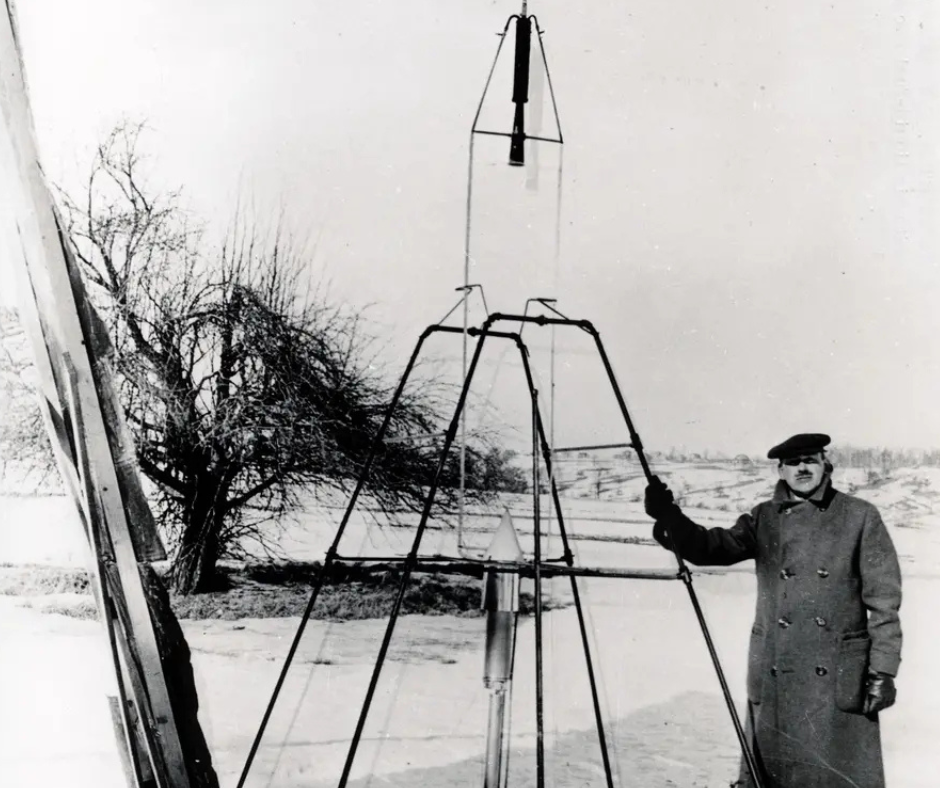
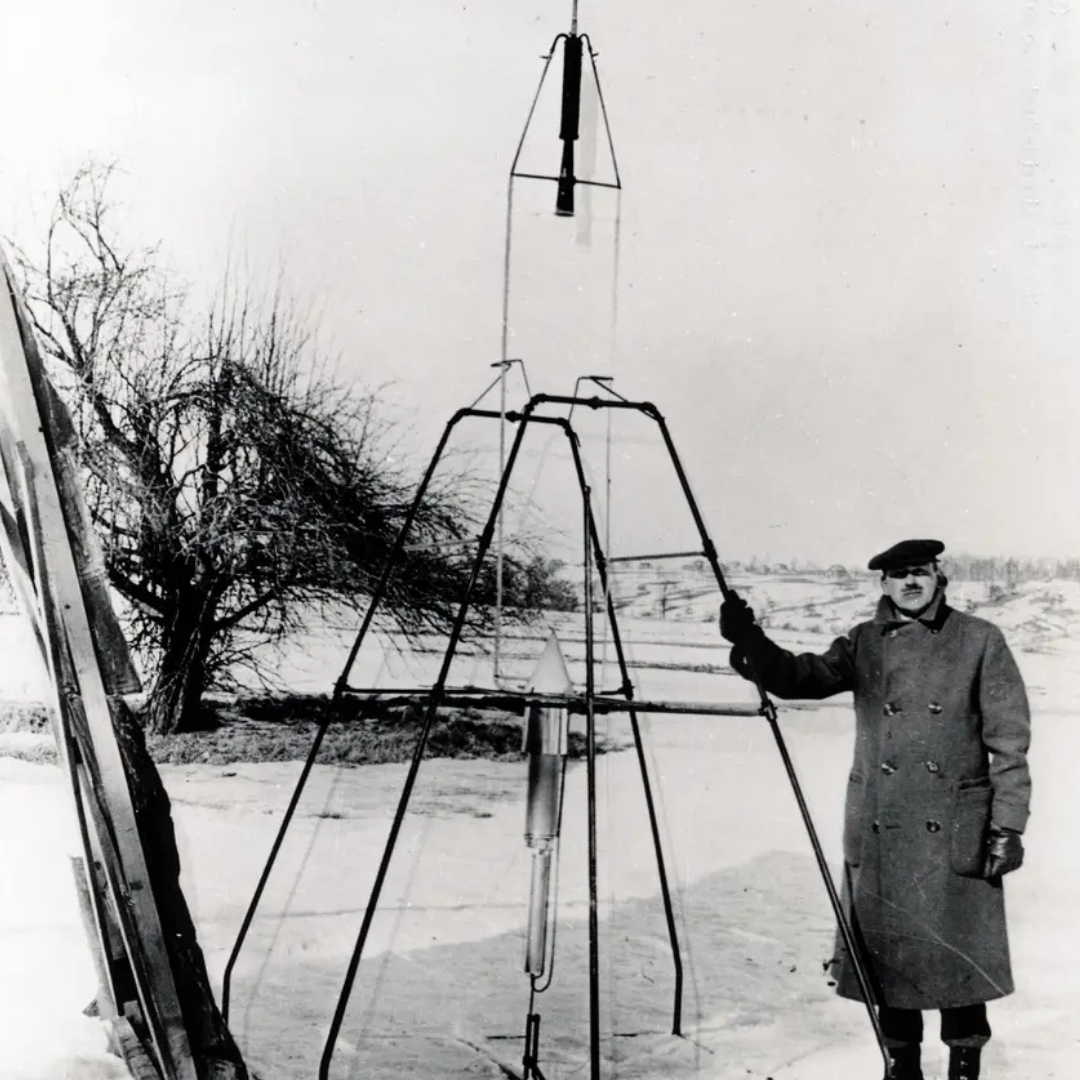
Robert H. Goddard and his
historic 1926 rocket launch.
The year 1926 marked significant milestones in engineering, including the establishment of Jones & Henry Engineers. But perhaps even more groundbreaking was the event that occurred that same year: the launch of the world’s first liquid-propellant rocket.
On March 16, 1926, Robert H. Goddard, a physics professor at Clark University, made history in a snowy field outside Worcester, Massachusetts. His rocket, a revolutionary yet straightforward contraption that burned a mixture of liquid oxygen and gasoline, took off for a brief 20 seconds. Although it only managed to reach a height of about 41 feet and traveled just 184 feet before crashing, the moment marked humanity’s first step toward space.
Interestingly, this historic launch went virtually unnoticed at the time. Goddard kept the event a secret for a decade, confiding in only a handful of people. Even the local newspapers failed to report on it, painting a picture of a scientist whose groundbreaking work remained largely unrecognized.
Goddard’s caution stemmed from a fear that others would steal his ideas. His paranoia intensified as Germany’s interest in rocketry burgeoned. Despite receiving substantial funding from aviator Charles Lindbergh in the early 1930s, Goddard spent most of that decade in Roswell, New Mexico, focused on developing larger rockets and pushing the boundaries of what was possible.
Goddard had fame inadvertently thrust upon him in January 1920 when the Smithsonian Institution published his treatise, “A Method of Reaching Extreme Altitudes.” The publication ignited widespread interest in rocketry and even spurred volunteers to offer their services for a hypothetical lunar mission.
In 1936, with pressure from the Smithsonian and his patrons, Goddard finally published details of his pioneering 1926 launch. Yet despite his substantial contributions to rocketry, he remained hesitant to collaborate, and as a result, his innovations eventually stagnated. The transformative advancements made by the Germans with their V-2 rockets did not escape Goddard’s attention. He died believing others stole his ideas, yet his contributions had laid the groundwork for future generations.
Before Goddard’s insights, rocketry was merely one of many speculative ideas. His treatise on reaching extreme altitudes shifted perceptions, embedding the rocket in the cultural consciousness as a principal technology for space exploration. With Goddard’s pioneering efforts and those of others around the globe, the possibility of space travel began to transform into a tangible goal.
In retrospect, Robert H. Goddard never realized the full extent of his influence during his lifetime. A catalyst for space exploration, his journey underscores the importance of vision, persistence, and collaboration in scientific progress.

Founded in 1926.
For a century, our name has been synonymous with innovative engineering solutions.